
Higher fuel prices are accompanied by accelerating service prices
The rise in inflation in September from 3.1% in August to 3.5% was primarily driven by transportation and fuel prices. Over the course of the month, gasoline prices rose by an average of 0.082 GBP to 1.695 GBP per liter, and diesel prices rose by 0.107 GBP to 1.925 GBP per liter. For gasoline, this was the highest price since August 2022, and for diesel, since July of the same year. Overall, fuel prices were 29.8% higher year-over-year, while in August the increase had been 23%. However, rising prices were also evident in broader indicators. Core inflation, which excludes energy, food, alcohol, and tobacco, accelerated from 2.6% to 2.8%. Inflation for services rose from 3.4% to 3.7%, with airfares falling less sharply after the end of the summer than they did a year ago. Restaurants and hotels had the opposite effect, with year-over-year price increases slowing from 4.1% to 3.8%. Food and non-alcoholic beverages maintained a growth rate of 1.3%. The data thus show divergent trends in individual household expenditure categories, with higher gas prices being the primary driver of the acceleration in overall inflation.
Bank of England assesses risk of prolonged price rises
At its September meeting, the Bank of England left the base interest rate at 3.75%. Six members of the Monetary Policy Committee voted to keep the rate unchanged, while three called for a 0.25 percentage point increase to 4%. The central bank had already warned at that time that a prolonged conflict in the Middle East was driving up energy prices and increasing the risk of persistent inflation. The updated short-term outlook from its staff projected inflation of approximately 3.75% in the fourth quarter of 2026 and slightly above 4% at the beginning of 2027. This is a conditional outlook based on energy prices at that time, which may change. A key factor in the bank’s decision-making is whether higher energy costs will lead to greater wage demands and further price increases for goods and services. In September, the bank assessed the evidence of a significant pass-through to wages and prices as limited; however, it considered the risk to be greater if high energy costs persisted for an extended period. At the same time, higher rates make loans more expensive and curb demand, which can dampen both inflation and economic activity. The bank will announce its next decision on November 5, when it will also be able to assess new data on September’s price increases. [2]
Debt exceeds 3 trillion GBP and interest costs are rising
According to preliminary data, the UK public sector’s net debt reached 3,005 billion GBP at the end of September, an increase of 91.7 billion GBP year-over-year. As a share of the economy, however, it stood at 94% of gross domestic product, which was 0.7 percentage points lower than a year ago. The crossing of the nominal threshold of three trillion GBP was therefore accompanied by a slight decline in the relative debt-to-GDP ratio. In September alone, the public sector borrowed 24.5 billion GBP, 1.9 billion GBP more than projected by the Office for Budget Responsibility. From April through September, borrowing totaled 97.8 billion GBP. Although this was GBP 4.4 billion less year-over-year, it exceeded the official forecast by GBP 6 billion. The central government’s interest expenses rose 16.6% year-over-year to GBP 10.9 billion, the highest September figure since monthly records began in 1997. Approximately GBP 4 billion of this amount consisted of an accounting increase in the principal of inflation-linked bonds, which is tied to the Retail Price Index. Therefore, the entire amount cannot be considered cash interest paid during that month. This mechanism also explains why rising prices directly increase part of the cost of servicing the UK’s debt.
The pound is also reacting to expectations regarding future interest rates and the budget
Higher inflation does not automatically guarantee continued growth for the pound. According to an early report from the currency portal Pound Sterling Live, the pound strengthened* following the release of the data, but quickly lost some of its gains. After an initial rise, the exchange rate against the euro hovered around 1.1917 EUR per 1 GBP, and against the dollar at 1.3373 USD per 1 GBP. This is because the market had already priced in a near-certain rate hike in November even before the inflation data was released. Joseph Capurso of the Commonwealth Bank of Australia considered a November hike likely, but did not anticipate the full series of further moves that investors had factored in. Sim Moh Siong of OCBC highlighted the high expectations for rate hikes as well as the risks associated with the upcoming budget, which the government will present on October 28. From the perspective of the currency market, it will therefore be crucial whether the new information supports the outlook already priced in or alters it. If the Bank of England signals a more cautious approach, the scope for further strengthening of the pound may narrow. At the same time, budget measures could change the assessment of the economic outlook and public finances. The pound’s future movement will therefore also depend on the gap between investor expectations and the actual decisions made by the government and the central bank. [3]
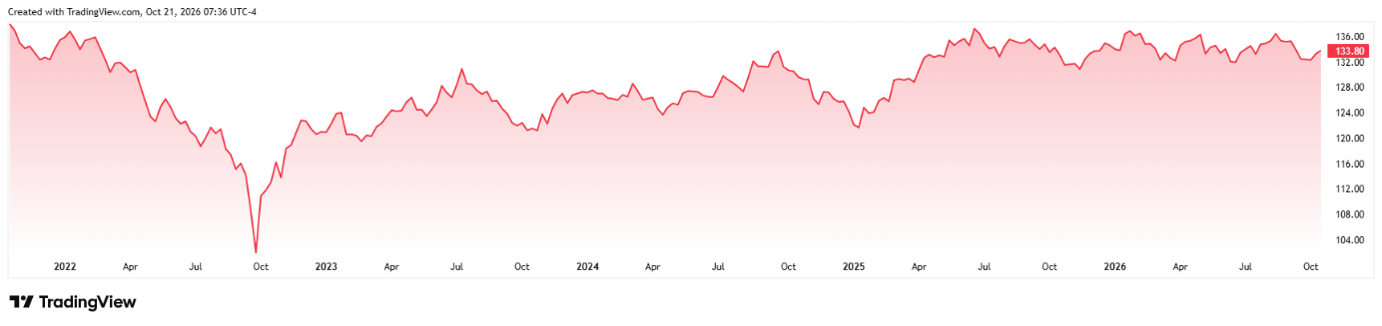
Performance of the British pound against a basket of selected currencies over the past 5 years*
Warning! This marketing material is not and should not be construed as investment advice. Past performance is no guarantee of future returns. Investing in foreign currencies may affect returns due to fluctuations. All securities transactions may result in both gains and losses. Forward-looking statements represent assumptions and current expectations that may not be accurate, or are based on the current economic environment, which is subject to change. These statements do not guarantee future performance. APME FX Trading Europe Ltd. is regulated by the Cyprus Securities and Exchange Commission.
[1,2,3] Forward-looking statements are based on assumptions and current expectations that may be inaccurate, or on the current economic environment, which is subject to change. Such statements are not a guarantee of future performance. They involve risks and other uncertainties that are difficult to predict. Actual results may differ materially from those expressed or implied in any forward-looking statements.
*Past performance is no guarantee of future results
Sources:
https://www.bankofengland.co.uk/monetary-policy-summary-and-minutes/2026/september-2026